When we first got chickens we thought we did a lot of research. There is nothing like trying them and seeing what works for you. But where do you start?
1. What do you want from your chickens?
This is going to be the most important question. If you want a breed that is great for laying eggs, then you do not want something that lays very little eggs or very few eggs. If your reason is meat, then you do not want something that will not give you what you want.
2. How are you going to house them?
How you are going to house them really makes a difference. If you are in the city or a small urban acreage and they will be confined in runs or huts, then you need a chicken that will do good in that situation. If you will have free range or pasture birds, then you need something that will fit in that environment.
3. What do you want to do with the chickens?
Will your chickens be pets, show birds, a backyard flock, or there for production only? Some birds are very flighty and not suited for pets.
4. What type of environment do you live in?
This is one people often forget. If you live in marshy areas where it rains a lot and is wet, then you need something suited to that. If it is very hot, you do not want something with a lot of feathers. If it is very cold, then something with a smaller comb is good.
5. Color of egg matters?
For some people it does. So, knowing the color of egg is something to be looked at. Eggs come in three primary colors. White, brown, and blue. There are varying shades within this group, but those are the primary three visual colors.
There are so many variations inside each of these questions that it would be impossible to narrow it down to one breed great for you. Personal opinion will always be part of it. So, how do you narrow it down? Well, that is where the questions help. Once you have the answers to the questions above I suggest you visit Henderson's Chicken Bred Chart. This is an excellent chart to narrow down your choices. Once you have an idea of what breeds you are looking for you can then source them out. My suggest on that one is highly dependent on where you live, but in general you can either purchase from a hatchery or breeder. If you look for a breeder you can Google it, look at local charters for that bred, or attend poultry shows. Information on hatcheries are readily available online. I hope this helps for those just getting started.

Here you will find the story's of a man, a woman, and their children, learning as we go, trying to create and manage a mixed farm.
Monday, June 17, 2013

Thursday, May 2, 2013
Unexpected kidding!
We had two baby goats born unexpectedly. They are twins, one boy one girl. Both are doing great now. When we purchased the mom we were told the wrong due date. Just goes to show, watch your animals. I was present for the birth, but thinking it was the wrong date, was prepared for the mom to abort, not deliver live babies. They are both premature, but strong. They love to play and eat. Oh man do they eat. Their mom had developed pregnancy toxemia. Which in goats is ketosis pre delivery. So we have two bouncing babies jumping and climbing everywhere.
Sounds pretty straight forward saying it like that doesn't it? Well, lets see if this will help put it in perspective.
Our Pearl (the mom goat) had stopped eating. We believed she still had two months of pregnancy left. We could not get her to eat anything. We tried Doritos, oats, wheat, barley, calf mana, alfalfa pellets, boss (black oil sunflower seeds), peanut butter sandwich, apples, bananas, spinach, berry's, twigs from maples, and several types of hay. She would eat none of it. Even tried to coat grains and such in sweet molasses, corn syrup, and brown sugar. Goats have a sweet tooth. She would only eat a few bites of grass hay a day for three days prior to her delivery. She was in great shape prior to this. I had noticed that she started to develop an udder and had asked some goat knowledgeable people and all agreed it was really early and to watch her. Well, I watched her.
Two days before she delivered she was acting off. She still refused feed, didn't want me to leave, would call for me.
Then the day she kidded (gave birth) I noticed about half way through the day that her stomach drastically dropped. That means that instead of looking fat, you saw her spine, a gap, then a stomach that was down to he knees. That is a precursor to birth. I know that from the cows.
Then about two hours later she had mucus. So, I knew then there was no turning back and she was in labor. Now, some background info on goats. Two months shy of a due date, the babies would not have been alive and they would have been hairless and tiny. So, I ran in the house, grabbed a garbage bag, sent a message to a friend about Pearl and hoped for info on what I could do. I logically knew I had no choice but to wait with her. But I wanted to be able to do something.
So, out I went. She was walking around pacing a lot. More mucus. No visible signs of impending birth. I go back into the house to draw up a b vitamin shot. I grab my phone so that I can check messages out in their hut. I go back out less then 10 minutes later. I am just in time to see the birth of the first twin. Not expecting to have any live births I had nothing with me. It is dark outside at this point and I have only a small light to see by. I notice it moved.
Wait, what?
It moved again. The bag was still covering it. Pearl, a first time freshener (first birth), didn't know what to do and the baby was too small to get out of the bag on it's own. Pearl moved away. I rushed over to remove the bag from the nose. Wait, it has hair. Ummm, it is breathing!
OMG, it dawned on me, the due date was very wrong. These guys still had round heads and no teeth. Goats are born with teeth. The hooves are still pure white. It is so cold outside it is shivering already. It is just laying there breathing.
Without thinking I grab it and put it in my coat and run in the house. As soon as I get in the door I yell for my daughter to grab a laundry basket and as many clean towels as she can find in a hurry. She is at the steps with the stuff by the time I get to the living room. I grab a towel, rip off my coat, remove my sweater, finish removing the sack from the baby and wrap it in a towel. At this point, I just know I have a breathing baby with hair (although it was not a full coat). As a second thought I check and it is a little doeling (girl). Oh wow.
Pure adrenaline is coursing through me now. I realize I still have the shot in my pocket, how it even got in my pocket and out of my hands I cant remember. So, I figure I will grab a few more towels and go check Pearl. All of that took less then 5 minutes. I run back out with a new sweater on. Coat is a mess, so it is left to be washed.
I go back out and I bump Pearl. It is similar to the Heimlich maneuver for a goat, but softer, to see if you can feel any other babies. I felt another one in there, it is distinctive when you feel it. So, I sit and wait. Less then 10 minutes later (15 minutes between babies) out comes the next one. I can see that Pearl is fatigued. She just lays there and I move the sack of it's nose like the first. She gets up, buts moves away again. I remove the sack and wrap it in a towel. This one is a tiny bit bigger then the first. I take it in, it is a boy.
So, now I have two premature baby goats in my house, a fatigued and confused first time freshener in the goat house, and my husband is supposed to be asleep because he has to get up for work in 3 hours, but instead he is holding our baby who is four months and screaming to be fed and put to bed. I rush out a bucket of warm molasses water to Pearl. She is downing that. I milk some colostrum (the first milk rich in antibodies). I come back in finish drying the babies, get new clean towels under them, and try to feed each a bit of colostrum from a bottle.
They have a suck reflex. Thank goodness!
So I lay them together, and cover them with a blanket to keep them warm. I take my own baby so hubby can sleep. I get her fed and in bed and by now it is almost 1 am. I pass out just hoping that everyone is alive in the morning.
5 am and I wake up. The baby goats have yet to make a sound. I check, they are breathing. I check and they are still breathing. Good sign. I go to check Pearl and take more molasses water. She drinks half and has past the placenta. All very good signs.
Hubby comes home on his breakfast break at 7 am to help me milk Pearl out. I feed the babies again. They can not stand. Then my baby gets up and my normal day starts. I then sit to take a breather.
Then the fun of raising two bottle babies. I took them to the vet soon after. Both had problems, but nothing they wont grow out of. They were three days old before they stood. Vet estimated them at 13 days early. At first I had to feed them every two hours like new born babies. They were just under 3 pounds each at birth.
First photo is them at 4 days old, sleeping. It is a normal pop can for size reference. Hooves has darkened and coats are growing, but still thin over the joints.
 Next photo is them today with one of our other goats, Snowflake. They are growing fast.

Just goes to show, be prepared for anything, no matter how improbable.
Sounds pretty straight forward saying it like that doesn't it? Well, lets see if this will help put it in perspective.
Our Pearl (the mom goat) had stopped eating. We believed she still had two months of pregnancy left. We could not get her to eat anything. We tried Doritos, oats, wheat, barley, calf mana, alfalfa pellets, boss (black oil sunflower seeds), peanut butter sandwich, apples, bananas, spinach, berry's, twigs from maples, and several types of hay. She would eat none of it. Even tried to coat grains and such in sweet molasses, corn syrup, and brown sugar. Goats have a sweet tooth. She would only eat a few bites of grass hay a day for three days prior to her delivery. She was in great shape prior to this. I had noticed that she started to develop an udder and had asked some goat knowledgeable people and all agreed it was really early and to watch her. Well, I watched her.
Two days before she delivered she was acting off. She still refused feed, didn't want me to leave, would call for me.
Then the day she kidded (gave birth) I noticed about half way through the day that her stomach drastically dropped. That means that instead of looking fat, you saw her spine, a gap, then a stomach that was down to he knees. That is a precursor to birth. I know that from the cows.
Then about two hours later she had mucus. So, I knew then there was no turning back and she was in labor. Now, some background info on goats. Two months shy of a due date, the babies would not have been alive and they would have been hairless and tiny. So, I ran in the house, grabbed a garbage bag, sent a message to a friend about Pearl and hoped for info on what I could do. I logically knew I had no choice but to wait with her. But I wanted to be able to do something.
So, out I went. She was walking around pacing a lot. More mucus. No visible signs of impending birth. I go back into the house to draw up a b vitamin shot. I grab my phone so that I can check messages out in their hut. I go back out less then 10 minutes later. I am just in time to see the birth of the first twin. Not expecting to have any live births I had nothing with me. It is dark outside at this point and I have only a small light to see by. I notice it moved.
Wait, what?
It moved again. The bag was still covering it. Pearl, a first time freshener (first birth), didn't know what to do and the baby was too small to get out of the bag on it's own. Pearl moved away. I rushed over to remove the bag from the nose. Wait, it has hair. Ummm, it is breathing!
OMG, it dawned on me, the due date was very wrong. These guys still had round heads and no teeth. Goats are born with teeth. The hooves are still pure white. It is so cold outside it is shivering already. It is just laying there breathing.
Without thinking I grab it and put it in my coat and run in the house. As soon as I get in the door I yell for my daughter to grab a laundry basket and as many clean towels as she can find in a hurry. She is at the steps with the stuff by the time I get to the living room. I grab a towel, rip off my coat, remove my sweater, finish removing the sack from the baby and wrap it in a towel. At this point, I just know I have a breathing baby with hair (although it was not a full coat). As a second thought I check and it is a little doeling (girl). Oh wow.
Pure adrenaline is coursing through me now. I realize I still have the shot in my pocket, how it even got in my pocket and out of my hands I cant remember. So, I figure I will grab a few more towels and go check Pearl. All of that took less then 5 minutes. I run back out with a new sweater on. Coat is a mess, so it is left to be washed.
I go back out and I bump Pearl. It is similar to the Heimlich maneuver for a goat, but softer, to see if you can feel any other babies. I felt another one in there, it is distinctive when you feel it. So, I sit and wait. Less then 10 minutes later (15 minutes between babies) out comes the next one. I can see that Pearl is fatigued. She just lays there and I move the sack of it's nose like the first. She gets up, buts moves away again. I remove the sack and wrap it in a towel. This one is a tiny bit bigger then the first. I take it in, it is a boy.
So, now I have two premature baby goats in my house, a fatigued and confused first time freshener in the goat house, and my husband is supposed to be asleep because he has to get up for work in 3 hours, but instead he is holding our baby who is four months and screaming to be fed and put to bed. I rush out a bucket of warm molasses water to Pearl. She is downing that. I milk some colostrum (the first milk rich in antibodies). I come back in finish drying the babies, get new clean towels under them, and try to feed each a bit of colostrum from a bottle.
They have a suck reflex. Thank goodness!
So I lay them together, and cover them with a blanket to keep them warm. I take my own baby so hubby can sleep. I get her fed and in bed and by now it is almost 1 am. I pass out just hoping that everyone is alive in the morning.
5 am and I wake up. The baby goats have yet to make a sound. I check, they are breathing. I check and they are still breathing. Good sign. I go to check Pearl and take more molasses water. She drinks half and has past the placenta. All very good signs.
Hubby comes home on his breakfast break at 7 am to help me milk Pearl out. I feed the babies again. They can not stand. Then my baby gets up and my normal day starts. I then sit to take a breather.
Then the fun of raising two bottle babies. I took them to the vet soon after. Both had problems, but nothing they wont grow out of. They were three days old before they stood. Vet estimated them at 13 days early. At first I had to feed them every two hours like new born babies. They were just under 3 pounds each at birth.
First photo is them at 4 days old, sleeping. It is a normal pop can for size reference. Hooves has darkened and coats are growing, but still thin over the joints.


Just goes to show, be prepared for anything, no matter how improbable.
Tuesday, April 2, 2013
Choosing livestock
One of the first things people need to think about if they plan to move to a farm, start a farm, ranch, hobby farm, or anything else with animals is what do I get? I dont think most people put enough thought into what they want to get until they have gotten a few things and realized it can be disastrous The first thing you need to take into account is your needs/wants. We were lucky in that this farm is a generation farm so it is debt free. We had to build our house, but the land was paid for. There was no animals here, so we had to put up fences, buy animals, shelters, etc. For most people, they will be buying the land, so money will be a factor in every day life. So your first thing you may want to do is cut down on your grocery bill. This takes time, effort, and money. I know, sounds odd, but growing your food is a long term investment and will pay for it's self, but not in a week.
So, growing your own food. You have veggies, fruits, beef, pork, chicken, turkey, dairy, etc. You have to choose what is going to be the first and easiest thing for you to do when starting off. Here are some guidelines that we learned the hard way.
1. First thing you need to do is make a list of what you want to accomplish. If it is just in your head then no one else will know. Your partner or children or family or friends that may be willing to help wont know what they can do or where to start without a list. Personally, I always make lists, it helps me see what is most important.
2. Prioritize that list. Which animal is most important to what you want to accomplish? Is it dairy? Poultry? Beef? It is all up to you. But how do you choose the importance? Well, here are a few things to help you accomplish that:
A. Which is easiest to start with for you? If you have no prior knowledge, chickens may be the easiest.
B. Which will be the cheapest to start up for you? Do you have fencing on your property or will you have to put them up? Do you have feeders and a way to water them? Will you have to buy feed for them or will you grow it?
C. Your personal comfort level. Some people are afraid of birds. Some wont go near a calf, much less a full size cow. Some are afraid the pigs will bite them. You have to really think and maybe visit a farm to see what you are comfortable with.
D. Is there anyone local to you that is willing to help teach you or will you have to learn on your own? That is a big one because if you start with say a dairy cow, that is expensive, but saves a lot of money. However, if they are not cared for properly they can die pretty fast. So you want someone to help you or have a great vet that is cheap.
3. Do research. Look at your list. Which thing was most important to you? Your research should be centered around the animal most important to you. Here is what you need to look for:
A. Social needs of the animal. Is it a herd animal? Then you have to have at least two. Is it a flock animal? Then 5 is better. Is it a small animal that will be caged like a rabbit? They can be alone.
B. How many of the animal chosen do you need to meet your goal? Do you want to have your own chicken to eat and eggs to eat? Do you want just enough milk to drink a day or do you want to make all your own dairy? You have to know how much you want from this animal to know how many of the animals it will take to produce that.
C. Space. How much space is needed for the amount of that animal that you want?
D. Fencing/Cage. How much fencing will you need to put up or how many cages will you need to build?
E. Feeding. How will you feed the said animal? Do you need commercial feed? Do you need hay? Do you plan to grow your own? Do they need minerals? BTW, if you think that you can ever get away without having to give any animal a mineral and you do not have perfect soil with no snow cover ever, then you are lieing to yourself.
F. Water. Most will think this is easy, and for most it is. If you live in a warm climate, then you have to understand that they will drink more and thus need more water, so will you have an automatic system or just fill them up twice a day? If it is a cold climate, really think about how you will keep the water from freezing or will you just give them water two to three times daily?
G. Shelter. What type of shelter is needed for that animal? If it is something like a rabbit, then you just need the cage and in the winter a small area they can get out of the wind. In the summer, they need shade. If it is cattle, will you build a barn or just a three sided lean to?
H. Medical care. Last but not least, how will you provide any vet care? Will you provide vet care? You will at least need to have a good vet that you can call and get medical advice from and that you can purchase the needed medications from.
4. Set goals. Now you know everything you need for your animal. So, where do you start? Well, first thing is containment Put up your fences! Your fencing needs to be suitable for the job. Dont use two strands of barbed wire if you are going to get goats. Dont use a 3' high fence if you are getting poultry. Put up proper fencing and you will have a lot of issues solved already. Next is the shelter. They will need it to get out of the weather. Then food and water set up. Set your goals according what you can accomplish.
5. Do your list! I know, repetitive. But you need to have everything ready before you bring home your new animal.
6. Now you are ready to get your animal. So, where do you go? Well, there are recommendations for every type of animal. But, to make it short, contact breeders, associations, neighbors, other farmers. Ask them if they know of anyone reputable to buy from. Soon enough you will hear just a few names that keep coming up. Your best bet will be to buy from those people.
7. Get your animal home and enjoy them. It is work, but if you let it, it can be enjoyable too.
So, growing your own food. You have veggies, fruits, beef, pork, chicken, turkey, dairy, etc. You have to choose what is going to be the first and easiest thing for you to do when starting off. Here are some guidelines that we learned the hard way.
1. First thing you need to do is make a list of what you want to accomplish. If it is just in your head then no one else will know. Your partner or children or family or friends that may be willing to help wont know what they can do or where to start without a list. Personally, I always make lists, it helps me see what is most important.
2. Prioritize that list. Which animal is most important to what you want to accomplish? Is it dairy? Poultry? Beef? It is all up to you. But how do you choose the importance? Well, here are a few things to help you accomplish that:
A. Which is easiest to start with for you? If you have no prior knowledge, chickens may be the easiest.
B. Which will be the cheapest to start up for you? Do you have fencing on your property or will you have to put them up? Do you have feeders and a way to water them? Will you have to buy feed for them or will you grow it?
C. Your personal comfort level. Some people are afraid of birds. Some wont go near a calf, much less a full size cow. Some are afraid the pigs will bite them. You have to really think and maybe visit a farm to see what you are comfortable with.
D. Is there anyone local to you that is willing to help teach you or will you have to learn on your own? That is a big one because if you start with say a dairy cow, that is expensive, but saves a lot of money. However, if they are not cared for properly they can die pretty fast. So you want someone to help you or have a great vet that is cheap.
3. Do research. Look at your list. Which thing was most important to you? Your research should be centered around the animal most important to you. Here is what you need to look for:
A. Social needs of the animal. Is it a herd animal? Then you have to have at least two. Is it a flock animal? Then 5 is better. Is it a small animal that will be caged like a rabbit? They can be alone.
B. How many of the animal chosen do you need to meet your goal? Do you want to have your own chicken to eat and eggs to eat? Do you want just enough milk to drink a day or do you want to make all your own dairy? You have to know how much you want from this animal to know how many of the animals it will take to produce that.
C. Space. How much space is needed for the amount of that animal that you want?
D. Fencing/Cage. How much fencing will you need to put up or how many cages will you need to build?
E. Feeding. How will you feed the said animal? Do you need commercial feed? Do you need hay? Do you plan to grow your own? Do they need minerals? BTW, if you think that you can ever get away without having to give any animal a mineral and you do not have perfect soil with no snow cover ever, then you are lieing to yourself.
F. Water. Most will think this is easy, and for most it is. If you live in a warm climate, then you have to understand that they will drink more and thus need more water, so will you have an automatic system or just fill them up twice a day? If it is a cold climate, really think about how you will keep the water from freezing or will you just give them water two to three times daily?
G. Shelter. What type of shelter is needed for that animal? If it is something like a rabbit, then you just need the cage and in the winter a small area they can get out of the wind. In the summer, they need shade. If it is cattle, will you build a barn or just a three sided lean to?
H. Medical care. Last but not least, how will you provide any vet care? Will you provide vet care? You will at least need to have a good vet that you can call and get medical advice from and that you can purchase the needed medications from.
4. Set goals. Now you know everything you need for your animal. So, where do you start? Well, first thing is containment Put up your fences! Your fencing needs to be suitable for the job. Dont use two strands of barbed wire if you are going to get goats. Dont use a 3' high fence if you are getting poultry. Put up proper fencing and you will have a lot of issues solved already. Next is the shelter. They will need it to get out of the weather. Then food and water set up. Set your goals according what you can accomplish.
5. Do your list! I know, repetitive. But you need to have everything ready before you bring home your new animal.
6. Now you are ready to get your animal. So, where do you go? Well, there are recommendations for every type of animal. But, to make it short, contact breeders, associations, neighbors, other farmers. Ask them if they know of anyone reputable to buy from. Soon enough you will hear just a few names that keep coming up. Your best bet will be to buy from those people.
7. Get your animal home and enjoy them. It is work, but if you let it, it can be enjoyable too.
Monday, April 1, 2013
What you learn.
Recently I posted about making butter and soft cheese. I had a friend ask me how I learned to do this. This year on the farm we have had some really joyous births and await several others. Again, I get asked questions concerning how I learned to care for these animals. It occurred to me that most people have gotten so far away from the farm and where their food comes from and how their food is made and grown that a lot of knowledge has been lost. For me, I mostly read the books dating back to the late 1800's as they have the best information that has nothing to do with commercial feeds. Then it is a lot of experimenting and putting everything into practice. I was raised in the city and before I moved here I had only grown a few veggies. It is amazing the things you can learn that after you learn it you sit back and go, wow, that is just common sense! So, I will try to tell you what I know and what I have learned and then we will learn more together.
Our farm raises Highland cows, Jersey cows, pigs, chickens, turkeys, rabbits, and goats. We use commercial feed for the rabbits only. The others we grow our own feed and just get minerals for them. We live in a climate that most would never live. It is a zone 1B. Yes, you read that right. 1B. We do get colder then that sometimes, but not for very long. The hardest thing is watering the animals as it freezes in less then an hour. Even a greenhouse will freeze in this weather in the winter. So, our choice of planting is very limited. We are still young at farming and still learning. If you think you can learn everything about farming or animals you might as well stop reading now. You will always learn something new.
So, what would you like to know about or learn first?
Our farm raises Highland cows, Jersey cows, pigs, chickens, turkeys, rabbits, and goats. We use commercial feed for the rabbits only. The others we grow our own feed and just get minerals for them. We live in a climate that most would never live. It is a zone 1B. Yes, you read that right. 1B. We do get colder then that sometimes, but not for very long. The hardest thing is watering the animals as it freezes in less then an hour. Even a greenhouse will freeze in this weather in the winter. So, our choice of planting is very limited. We are still young at farming and still learning. If you think you can learn everything about farming or animals you might as well stop reading now. You will always learn something new.
So, what would you like to know about or learn first?
Friday, March 15, 2013
What is Clean?
I wonder if I can even remember the meaning of the word, Clean. Growing up in the city and living mostly in town houses or apartments, I got used to small spaces. I don't mind them very much. But, I do like them to stay clean so that I am not stepping on things. I don't mind dust. But my floors, that is my pet peeve! I really don't mind having toys on the floor from the kids. What gets me is the dirt, straw, mud, stuff, that ends up on the floor and spread over the whole house in a matter of an hour of the floors being mopped. I like to get out of the shower, walk across my floor, and still have clean feet! We have hardwood floors because carpet and farm just doesn't mix. Even with rugs at both doors, it seems to spread like wild fire. You cant keep shoes outside as the winter is 7 months and snow and below 0 temps for most of it. In the summers we have spiders so badly, again, you cant just leave shows outside. So, I have a rule, shoes off at the door and there is a shelf to put them on. For the most part, everyone follows it. At the front door, very quickly, I get a mound of wet dirt, straw, and everything else you cam imagine from a farm. Oh yes, and we don't have real dirt. It is red clay mud!
Now, small children don't seem to care what they step in and where they track it. So, with them running through out the house, it gets tracked from the door, through the kitchen, into the living room, and it is a mess. Now, we live on a farm. Yeah, I know you know that, but do you understand what that means? That means (especially in winter so they don't freeze) going out four times a day to check for eggs, going out twice a day to milk and then feed calves, to go out and water everyone which requires hauling it by the bucket out of the house to each and every animal, and then going out to feed all the animals. Why don't we try to do all of it at once you ask? Kids! With a 3 month old I am nursing, I can only be gone for an hour or so (and that is if DH is home) before I have to come in and take care of what ever I have done and get washed up to feed said infant. Not to mention cooking breakfast, lunch, and dinner for the other children in the household. So, it is done in spurts. If DH is at work, so most of the week, it is done in spurts as fast as I can. Usually during said infants nap time. So, that is A LOT of in and out. And that is just by me. That isn't including DH going in and out, DD1 letting the dog out to go potty, DD2 thinking she has to follow me everywhere, well, you get the point. So, we have migrating mess on the floor several times a day. While I am outside DD2 thinks she has to open the door and yell for me every two to three minutes, thus tracking it further and further in the house.
You would think that hardwood floors would allow you to keep it cleaner, I have to say, maybe cleaner, but never looks clean. No sooner does it get mopped then it gets tracked on. Is there such a thing as a clean house on a farm? I say it can be. Is there such a thing as a clean house with small children? I say sure. Is there such a thing as a clean house on a farm with children? Sure thing is one of the two adults don't have to do chores outside and just has to clean inside. So, in reality, is there such a thing as a clean house, with small children, and in this day in age where one parent is working and the other is home and thus has to do chores outside as well as inside? Nope! At least not in this house. One day, maybe. For now, the problem is solved with slippers!
Now, small children don't seem to care what they step in and where they track it. So, with them running through out the house, it gets tracked from the door, through the kitchen, into the living room, and it is a mess. Now, we live on a farm. Yeah, I know you know that, but do you understand what that means? That means (especially in winter so they don't freeze) going out four times a day to check for eggs, going out twice a day to milk and then feed calves, to go out and water everyone which requires hauling it by the bucket out of the house to each and every animal, and then going out to feed all the animals. Why don't we try to do all of it at once you ask? Kids! With a 3 month old I am nursing, I can only be gone for an hour or so (and that is if DH is home) before I have to come in and take care of what ever I have done and get washed up to feed said infant. Not to mention cooking breakfast, lunch, and dinner for the other children in the household. So, it is done in spurts. If DH is at work, so most of the week, it is done in spurts as fast as I can. Usually during said infants nap time. So, that is A LOT of in and out. And that is just by me. That isn't including DH going in and out, DD1 letting the dog out to go potty, DD2 thinking she has to follow me everywhere, well, you get the point. So, we have migrating mess on the floor several times a day. While I am outside DD2 thinks she has to open the door and yell for me every two to three minutes, thus tracking it further and further in the house.
You would think that hardwood floors would allow you to keep it cleaner, I have to say, maybe cleaner, but never looks clean. No sooner does it get mopped then it gets tracked on. Is there such a thing as a clean house on a farm? I say it can be. Is there such a thing as a clean house with small children? I say sure. Is there such a thing as a clean house on a farm with children? Sure thing is one of the two adults don't have to do chores outside and just has to clean inside. So, in reality, is there such a thing as a clean house, with small children, and in this day in age where one parent is working and the other is home and thus has to do chores outside as well as inside? Nope! At least not in this house. One day, maybe. For now, the problem is solved with slippers!
Wednesday, March 6, 2013
Tricky Chicky
One of the most bothersome and annoying things that happens on a farm with animals is the escape artist! They can be any animal, at any time, and in any circumstance. It can be a one time thing or an every day thing. Here is one such story of one of those animals at one time.
A week and a half ago we had gotten a few chicks. DH had wanted some black copper marans for a while and we finally got some. Well, it is still around 15 F outside, so the chicks would not live out there. They were just a few days to a week old and were not feathered out yet. We have two wooden show boxes for poultry with a wire front and everything else is solid. If I turn them on their backs then the wire faces up and they make great brooders for very small amounts of chicks. So, I set them both up, split the chicks to have five in each box, get the straw in the bottom, the feeders full of food, and the waterers on the stands. I have them in the house because they wont survive outside. A small number of chicks is ok to be inside, but a large number will make too much dust! So, the chicks are all set up and in their brooders and growing fast and feathering out well. Now, some chicks are more inquisitive then others. Some just want to run and others like to see what is going on and those are always the first to say hi and see what you have. Well, I know that in every breed there are different personalities. So I should not have been surprised when I found that one little chick loved to see what was going on in the house. It would get on top of the waterer and stick it's head out of the top of the brooder and look around.

This went on for a few days and it just looked around. Watched very intently what was going on. Now, I have a dog in the house. The chick could clearly see the dog. If someone walked by the brooder it would get down and act as if nothing was happening. If the dog went to investigate it would jump down in a game of you cant catch me. I was finding it funny that this little one was so intent on seeing the world.

Well, I was sitting in the living room and I heard some flapping. I look up and that little chick is on top of the waterer again. I smile and watch it for a moment and then as I start to turn I notice it is jumping. I knew that if it's wings were open there is no way it could get through the wire. So I don't think much of it, but I watch to see what it is doing. Then I notice, it is jump and grabbing the wire with it's beak. At this point I start laughing and wondering if this is a chick or a parrot! So, the head, neck, and part of the chest is above the wire, the chick's legs are stretched straight out to make it as tall as possible. Then his head disappears for a split second and then up it comes. It gets all the way to it's stomach and then falls back in as it's tail caught the back of the wire. So, I watch longer just to see what it does. It trys it again. And again. And again, but this time, it grabs the wire in front of it as it jumps and pulls its self up onto the top of the wire. It's tiny chick feet grasping this thin wire trying to keep it's self up right and flapping its wings in an effort to not fall. So, now this tricky little chicky have figured out how to get out of the brooder.
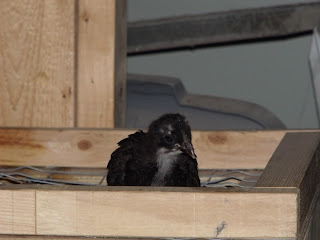
Wonderful. Now I have a new escape artist. So, now I cover that part of the wire so that the chick cant get out while on the waterer.
A week and a half ago we had gotten a few chicks. DH had wanted some black copper marans for a while and we finally got some. Well, it is still around 15 F outside, so the chicks would not live out there. They were just a few days to a week old and were not feathered out yet. We have two wooden show boxes for poultry with a wire front and everything else is solid. If I turn them on their backs then the wire faces up and they make great brooders for very small amounts of chicks. So, I set them both up, split the chicks to have five in each box, get the straw in the bottom, the feeders full of food, and the waterers on the stands. I have them in the house because they wont survive outside. A small number of chicks is ok to be inside, but a large number will make too much dust! So, the chicks are all set up and in their brooders and growing fast and feathering out well. Now, some chicks are more inquisitive then others. Some just want to run and others like to see what is going on and those are always the first to say hi and see what you have. Well, I know that in every breed there are different personalities. So I should not have been surprised when I found that one little chick loved to see what was going on in the house. It would get on top of the waterer and stick it's head out of the top of the brooder and look around.

This went on for a few days and it just looked around. Watched very intently what was going on. Now, I have a dog in the house. The chick could clearly see the dog. If someone walked by the brooder it would get down and act as if nothing was happening. If the dog went to investigate it would jump down in a game of you cant catch me. I was finding it funny that this little one was so intent on seeing the world.

Well, I was sitting in the living room and I heard some flapping. I look up and that little chick is on top of the waterer again. I smile and watch it for a moment and then as I start to turn I notice it is jumping. I knew that if it's wings were open there is no way it could get through the wire. So I don't think much of it, but I watch to see what it is doing. Then I notice, it is jump and grabbing the wire with it's beak. At this point I start laughing and wondering if this is a chick or a parrot! So, the head, neck, and part of the chest is above the wire, the chick's legs are stretched straight out to make it as tall as possible. Then his head disappears for a split second and then up it comes. It gets all the way to it's stomach and then falls back in as it's tail caught the back of the wire. So, I watch longer just to see what it does. It trys it again. And again. And again, but this time, it grabs the wire in front of it as it jumps and pulls its self up onto the top of the wire. It's tiny chick feet grasping this thin wire trying to keep it's self up right and flapping its wings in an effort to not fall. So, now this tricky little chicky have figured out how to get out of the brooder.

Wonderful. Now I have a new escape artist. So, now I cover that part of the wire so that the chick cant get out while on the waterer.
Butter Anyone?
In sticking with the spirit of using what we have and throwing out less and making things stretch I decided to try cultured butter from whey. I had NO idea that cheese wasn't the butter fat. I knew it was butter, but I thought that cheese took that too. I was so wrong. Apparently, once you make cheese (non acid cheese) you can separate the cream and butter fat out of the whey and use that to make cultured butter. I used a recipe I found online to make it.
I took my cream separator and separated the whey after I my attempt at cottage cheese the other day. I had read that you can make cultured butter out of this whey. I got a really good amount of cream out of the whey and put it in the fridge to cool off. I let it get down to about 56F and then put it in my blender like the recipe said you could. It started to separate, but would not clump. I tested it and the temp and shot all the way up to 90F. So, I put the mixture in the metal bowl of my mixer and throw it in the freezer.
Now, this whole time I am in my kitchen doing this, I am very skeptical I am thinking, who in their right mind would every make butter from whey? I was sure it would taste really nasty. Thinking it wasn't going to work no matter how cool I got the cream again. It looked weird and I thought the whole idea of making butter from whey was weird. I think that I should mention, I live in Canada, but I am American and was raised the in USA. You say butter there and they dont ask if you want sweet cream or cultured, they ask if you want salted or unsalted. I must have lived a very sheltered life as I had heard of cultured butter but had no idea what it was or even tasted like. Everyone knows that you take your cream off the top of your milk to make sweet cream butter, BEFORE you make your cheese, not after! So this process seemed very odd to me, making butter from whey. Oh boy do I have a lot to learn!
So it gets back down to temp and I use the paddle of my mixer and guess what? I watch it and it is starting to clump! After the cottage cheese fiasco I was stunned that this was working! So, I keep watching and there it is, a beautiful ivory colored lump of butter. Did you know that your cream and butter will be ivory instead of yellow if the cow is fed more grain and less pasture? Pastured cows will produce a golden yellow cream and butter. Since it is winter here and our pasture is under three feet of snow, our cows are fed grass hay and get grain making it ivory. So, I rinse it three times until the water is clear and then I press out any water. I put it in the fridge (more afraid to taste it this time then with the cottage cheese) and let it harden a bit. I didn't add salt to it as I usually don't like salted butter, but that is sweet cream butter. The next day I taste it. WOW! Amazing flavor. I am shocked it tasted good. I had heard so much bad about cultured butter, but this was great. But next time I will add a little salt! I kept hearing about it having a sour flavor with what I read. I really detest the taste of plain cultured buttermilk. Yet I like buttermilk pancakes. Odd I know! Anyway, I assumed that it would taste similar to buttermilk and it's sour flavor. Nope. Now, I have also read that the butter flavor will be slightly different depending on the cheese you use and what the cow is fed. I found this cultured butter very easy to do and a great flavor. It is one that I will have to keep around my house. But, that means I will have to keep trying to make cheese too! In time.
*Update*
I was asked recently what the flavor of the butter is like. Well, the best way I can describe it is to take 1/2 cup of your regular butter, add in about 1 tsp sour cream, and whip it together. The texture is very light. Not heavy. More like a whipped butter from the store. Also, you know that oily residue left in your mouth after you eat store butter? Yeah, that isnt there. It melts so easily in the mouth too.
Subscribe to:
Posts (Atom)